Wednesday, February 24, 2010
Monday, February 08, 2010
Meanwhile, back home....
Our neighborhood digs out from Friday & Saturday's monster storm. Here's our street (photos courtesy of our neighbors as we're clearly NOT there to take them):
Those lumps in the driveway ARE cars. Two are ours, two are the neighbors'. You can see the construction NOT happening on the nieghbor's house....
Friday, February 05, 2010
Hanging out in Mission Beach
Thursday, February 04, 2010
Balboa Park on a "Cloudy" Day
We had to go up the valley today to run errands, so we decided to bop over to Balboa Park for lunch and strolling. I love the bell tower of the California Building (built in 1914) there. Note that this was a cloudy day in San Diego.
Wednesday, February 03, 2010
A bad day in San Diego....
Sunday, November 29, 2009
Arlington National Cemetery
Fred has been reading "The Lady of Arlington" about Mary Anna Randolph Custis Lee, Robert E. Lee's wife, so we decided to head over to Arlington National Cemetery to sightsee.

Mary was the daughter of George Washington Park Custis, who was adopted and raised by George Washington (his step-grandfather). GWP Custis designed and built Arlington House in honor of his adopted father. It became the home of Robert E. Lee upon his marriage to Mary Custis. At the beginning of the Civil War, the Federal government seized the Custis-Lee mansion (Arlington House) which overlooked the city and quartered troops there. The Federal government decided the mansion was the perfect place for a badly needed cemetery both practically (the Lees/Custises had a lot of land) and as an act of retribution against the Lees. After the war, the courts ruled that the land had to be returned to the Lee family, but it was no longer livable. By war's end, 16,000 graves surrounded the mansion. Robert E. Lee's son and heir, George Washington Custis Lee, sold the home back to the government for $150,000.
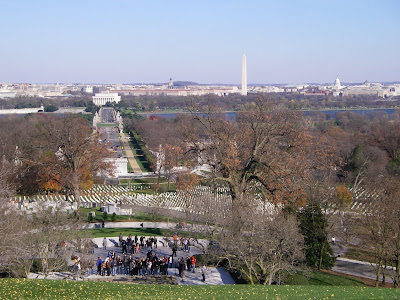
Above, the view of Washington, DC from the front yard of Arlington House. The people in the foreground below are visiting the grave of President John F. Kennedy. That's Memorial Bridge crossing the Potomac River into Washington, DC with the Lincoln Memorial, the Washington Monument and also the Capitol dome visible.
It's been years since I'd been to the Kennedy grave site at Arlington. When I was a kid, we visited soon after the burial. The last time I remember being there, it had a gravel walkway past it. Now it's very formal. That's the front portico of Arlington House atop the hill. Below, the visitors file by the grave site. Jacqueline Kennedy Onassis and the two children who died as infants are also buried there.
President Kennedy's brothers Robert F. Kennedy and Edward Kennedy are also buried near the President's grave site. Below, Edward (Teddy) Kennedy's grave.
Arlington National Cemetery, part II
The grave of Pierre Charles L'Enfant, in front of Arlington House, with a view of the city he designed under direction of President George Washington. L'Enfant was originally buried in Maryland and was re-interred here in 1909.
President William Howard Taft dedicated the L'Enfant monument on May 22, 1911. President Taft, one of two Presidents buried at Arlington Cemetery, is the only person to have been both President of the US (1908-1912) and Chief Justice of the Supreme Court (1921-1930). He died five weeks after his retirement from the Court. His wife Helen Taft, also buried here, was instrumental in bringing the cherry trees to Washington.
Abner Doubleday, who aimed the first Union gun fired in defense of Ft Sumter but who did NOT invent baseball, is buried in Section 1, near the Arlington House. He DID later start the first cable car company in San Francisco.

More information about Abner Doubleday and other famous people buried at Arlington Cemetary can be found here:
www.arlingtoncemetery.org (the official site)
and
www.arlingtoncemetery.net (private site)
Tired, hungry and a bit cold, we headed home!
More information about Abner Doubleday and other famous people buried at Arlington Cemetary can be found here:
www.arlingtoncemetery.org (the official site)
and
www.arlingtoncemetery.net (private site)
Tired, hungry and a bit cold, we headed home!
Thursday, August 06, 2009
London--Soho and Jersey Boys
Fred and I always like to see a play while in Lond0n--there is a huge variety and, compared to US prices, you can get some deals. We decided to go see Jersey Boys. The Prince Edward Theatre is down in Soho, and it was packed. Here are some of the crowds outside one of the bars as we left the theatre (it was a great show!)
Quiet Day in London
Fred and I waved goodbye to Peg and Sue, then got up and took the laundry to be washed at the laundramat almost next to the hotel. Saw this MINI and Fiat 500 parked next to the hotel.

Then, we went for a walk in Hyde Park. Saw some cool birds (see www.birdlist.blogspot.com)
Wednesday, August 05, 2009
London Sights
On our way back from the War Museum, we checked out the London Eye, which we rode on our last trip. This immense Ferris wheel never stops moving, one has to step on to the car as it slowly moves by. It was quite controversial, I suppose it still may be, but the crowds to get on were immense.
The Eye is right across the Thames from Parliament, Big Ben, and Westminster Abbey (the low white double towers to the right of Big Ben).
Imperial War Museum, London--Part II
There was a maze in the basement that took one through both WWI and WWII. We spent a good bit of time in the WWI exhibit as we didn't know much about it, compared to WWII.

There were display cases about many different aspects of the war. This was part of one about protective gear, both German and British. That's some kind of gas mask.
A scene from trench life. There would be three trenches: a front line trench, a supply trench and a recovery trench. I believe this scene would have been in the recovery trench, the furthest from the front line. Communication passages linked the trenches. There were signs "Do Not Leave the Trenches in Daylight."
We did go through a bit of the WWII exhibit. Here is an Enigma machine, the German encoder/decoder broken by the Allies.
Subscribe to:
Posts (Atom)


